
"Let's make the living room lighter."
The designer changes the sofa, the rug and the wall finish. The client looks at the new version: "No, the previous one was better. I meant that the picture looks dark."
A few hours went into solving the wrong problem.
Revisions are a normal part of interior design. But the number of redos climbs when people understand a comment differently, discuss different versions, or start changing materials before they've defined the result they want.
Handling revisions in a design project is a sequence: clarify the comment, define the scope of the change, confirm you understood, make the change and check the result. It also helps to tell apart three things: fixing a mistake, refining a proposed solution and changing the original task.
First find out what exactly the client doesn't like
"I don't like it" is not an assignment for a redo. But you shouldn't expect a professional explanation from the client either.
Help them describe the impression through a specific object, a property or a way of using the space.
| Comment | What to clarify |
|---|---|
| "The interior is too cold" | Is it the shades, the materials or the feel of the lighting? |
| "The sofa feels unwelcoming" | Is it the shape, the upholstery, the depth or the height of the back? |
| "It's cramped here" | Is the walkway awkward, is there too little free space, or is it just the impression from the image? |
| "I want it like in this photo" | What exactly should be repeated: the palette, the composition or one item? |
| "We need more storage" | For which things, and in which room? |
It is better to ask one or two pointed questions than to send ten new options right away.
Example reply:
Let me check so I change the right thing: in the living room, do you want a lighter palette, or does it just look dark in the image? And do we keep the layout and furniture?
This message clarifies the comment and checks the limits of the change at the same time.
Separate a mistake, a refinement and a new task
Not every comment should be handled the same way.
A mistake or a mismatch. The brief calls for a workspace for two people, and the proposal has one. First check the original requirements and fix the discrepancy.
A refinement of a solution. The layout works, but the client asks to change what goes inside a wardrobe. Clarify the details and check what they affect.
A change of task. After an apartment with two bedrooms is designed, the client decides to add a separate study. That may mean revisiting several rooms and the materials that depend on them.
Don't pick the category based only on how long the work will take. A small change can touch drawings that have already been issued, while a visible visual adjustment can stay within the current discussion.
Before deciding, check the brief, the specification, the options accepted earlier and the agreed scope of services. If the scope, the timing or the cost changes, discuss it before the redo starts.
Collect comments on one version
On Monday the client asks to remove the armchair, on Tuesday they send a new one, on Wednesday they suggest bringing the old one back. If the designer starts making each change right away, the work keeps canceling itself.
Suggest that the client first look at the whole material and collect comments on a specific version.
Please look at the whole living room concept and collect your comments on this option. After that I'll put them into one list, clarify the disputed points and make the changes.
This doesn't forbid questions along the way. The goal is to know when the feedback is complete and the revision can start.
If several people discuss the project, agree on how they give one shared answer. Contradicting wishes from two spouses shouldn't turn into two parallel tasks for the designer. More on pinning comments to details in image annotations vs chat comments.
Before the revision, write a short list of changes
Collected feedback doesn't mean everything is clear yet.
Boil it down to a few points and separate what stays.
Example:
For the living room we change the sofa upholstery to a warmer one, look for a coffee table without glass and remove the open shelves on the right. The layout, the armchair and the wall finishes stay. I'm not working on the light fixture yet: we're waiting for your choice of two options. Is that right?
A list like this reveals a mismatch before you prepare new materials.
On a team, add who does what. "Change the living room" is hard to hand to a colleague. "Replace the upholstery on the chosen sofa and update the mood board" is much clearer.
Change what you agreed on
Sometimes, in response to one comment, a designer also reconsiders the neighboring decisions. The new version becomes harder to judge: the client asked for another shade of sofa and got a different living room.
If a change really does require revisiting the surroundings, explain the dependency:
A bigger sofa will shorten the way to the window. We can choose a compact model or move the coffee table. I'll show both solutions before updating the whole concept.
If there is no such dependency, keep everything else as it is. Then the client compares exactly the change they asked for.
Show what changed in the new version
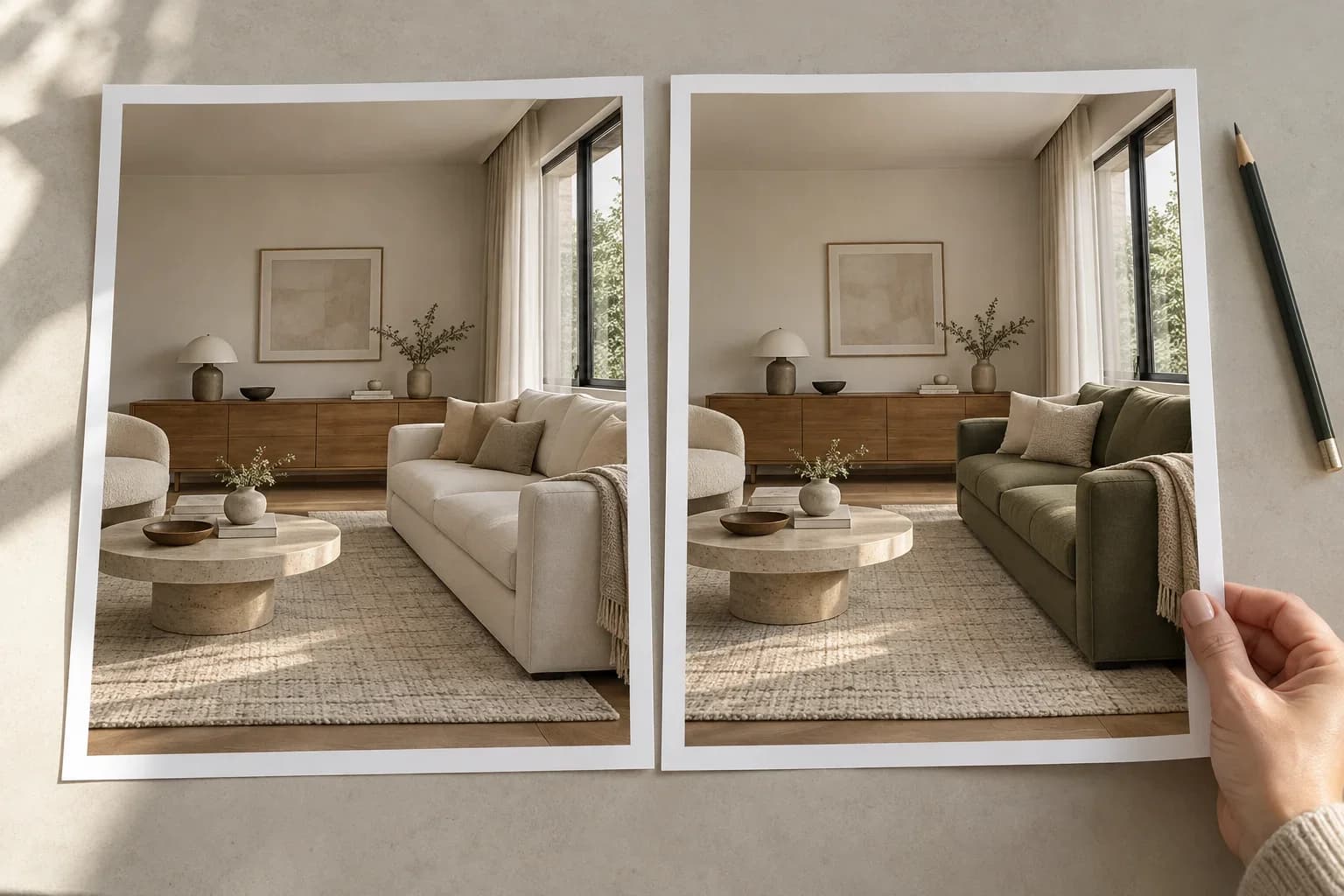
When you send an updated material, don't make the client look for the differences on their own.
A short note is enough:
Living room, version 03. I changed the sofa upholstery, replaced the coffee table and removed the open shelves. The layout and wall finishes are the same. Please check whether these three comments are resolved.
Use sequential file names: LivingRoom_v02, LivingRoom_v03. Names like "final", "really final" and "final new" quickly stop helping.
Old materials are kept for history, but the current version has to be obvious. This matters most when the person handling the procurement list, a drafter or a contractor works from it next.
If the client goes back to an accepted decision
"We still want a different option" doesn't necessarily mean a conflict. The person may have seen a sample in real life, changed their budget or re-evaluated their needs.
First find out the reason. Then show the consequences.
We can go back to this decision. Right now it is already reflected in the layout and the kitchen elevations. I'll check which materials need updating and suggest the scope of work and a new date. Once you confirm, we'll start the changes.
A reply like this doesn't promise a redo before an assessment, and it doesn't argue with the client's right to change their mind.
You don't need to automatically declare every revision an additional service. The basis for that decision is the specific agreements and the nature of the change, not irritation at a new message.
What to do with revisions from voice messages and meetings
Spoken discussion works well for hard choices, but its result is worth turning into a short written record.
After the conversation, send:
- what you decided to change;
- what stays;
- which questions are still open;
- what you're doing next.
Ask the client to check the final wording, especially if several alternatives were discussed during the talk.
Don't write every idea that was voiced into the result. "We could try green" and "we chose green" are different decisions.
How to handle revisions in Roomix
In Roomix, a client can leave comments right on images. That ties a comment to a specific detail, for example showing which cabinet or light fixture needs discussion.
Use a simple order:
- Send the material and say what you're asking them to judge.
- Collect the comments and clarify the ambiguous wishes.
- Sum up in the project chat.
- Assign the necessary tasks to yourself or your team.
- Add the updated material and explain the changes.
- Send the final version for approval.
When a client approves, their name, the date and the time are saved. The brief and the specification generated from it inside the project help you return to the original requirements if the wishes change.
A comment on its own isn't a ready task. First understand what it means, then define the action and the person responsible.
Open Roomix and discuss materials with your client.
Check before sending an update
Before the next send, open the list of comments and compare it with the result:
- Are all the agreed changes made?
- Did something change by accident that you decided to keep?
- Are any questions left unanswered?
- Do related drawings or the procurement list need updating?
- Is it clear which version the client is looking at now?
The goal isn't to remove revisions from a designer's work. Each revision should answer a clear request, and each new version should bring the project closer to a decision.